 If you are like most people I know, you have way too many meetings. That leads to an overcrowded calendar and delayed decisions. Worse, it means the time you spend in meetings prevents you from doing “your” work, whatever that work is. That's especially important the more responsibility you have.
The greater your responsibility, the more time you need to think. And too many meetings are not structured so we can think about big problems and how to solve them. (That's another topic for another day.)
Most of us do not need the number of meetings we have on our schedules. What can we do?
Take a look at your calendar. Start by deciding on invitations from other people.
Review Invitations from Other People
First, eliminate all the meetings that do not have an agenda. You can decline and let the person know that you do not go to meetings without an agenda. (See Manage It! and the entire chapter on meetings to see your alternatives.)
Then, ask yourself these questions:
- How many of those meetings do you really want to attend? If none, is there someone who should be at this meeting? Can you delegate this meeting to that person? (You might have to coach that person so they can be effective in that meeting.) Too often, we get stuck with recurring meetings because those discussions were part of our previous responsibilities.
- Do those meetings need you to make a decision? If not, you do not have to go. However, you might need to know the outcomes or decisions from those meetings. In that case, tell the meeting inviter that you want the information even though you do not need to make any decisions.
If you're lucky, you just eliminated half the meetings. That will give you some time back in your week. Now, look at your meetings. Which of those meetings do you need?
Review the Meetings You Create
First, make sure you have an agenda, so everyone is ready for the meeting. (See the Manage It Templates for a possible project meeting agenda.)
Regardless of the type of meeting, start with this data so other people know if they should attend your meeting:
- The date, topic, location, and the invited people at the top of the agenda.
- The items you want to discuss and the decisions you would like to see. Not the already-defined “We will agree on this product strategy,” but “Choose the product strategy for the next quarter. I know of these options so far…”
- Any preparatory detail people need in advance, so they are ready for the meeting.
Consider timeboxes for each item on the agenda. In general, if I think people need time to consider an item, I will write a document. Send that doc in advance, and remind people 24 hours in advance that I want them to read it.
I'm also open to the idea of leaving 5-10 minutes at the start of the meeting to read and discuss that doc before we discuss the question(s) at hand.
Now that you have an agenda, make sure you have the right people so you can decide now and then choose when to review that decision.
Decide Once, Choose When to Review
Many management decisions require a decision now and then periodic review. Most of those are risk-based decisions, such as:
- The product architecture, which can affect the product backlog, roadmap, and even the corporate strategy.
- The product strategy which can affect the product backlog, the product strategy, the project portfolio, and the corporate strategy.
- Impediments that affect cycle time, which can affect all of the product and strategy decisions.
You might have other risks that require different kinds of decisions.
In all my experience coaching and consulting with managers, I have learned these truths:
- Ambiguity is actually our friend, because we never have enough “real” data to make a truly informed decision when we need to make that decision.
- We can get some data that has to be enough for now. (See the various visualizations of sufficient data in How Multitasking Affects Capitalization and What You Can Try Instead.)
- Because the data will change, we can manage ambiguity by deciding when to make another decision.
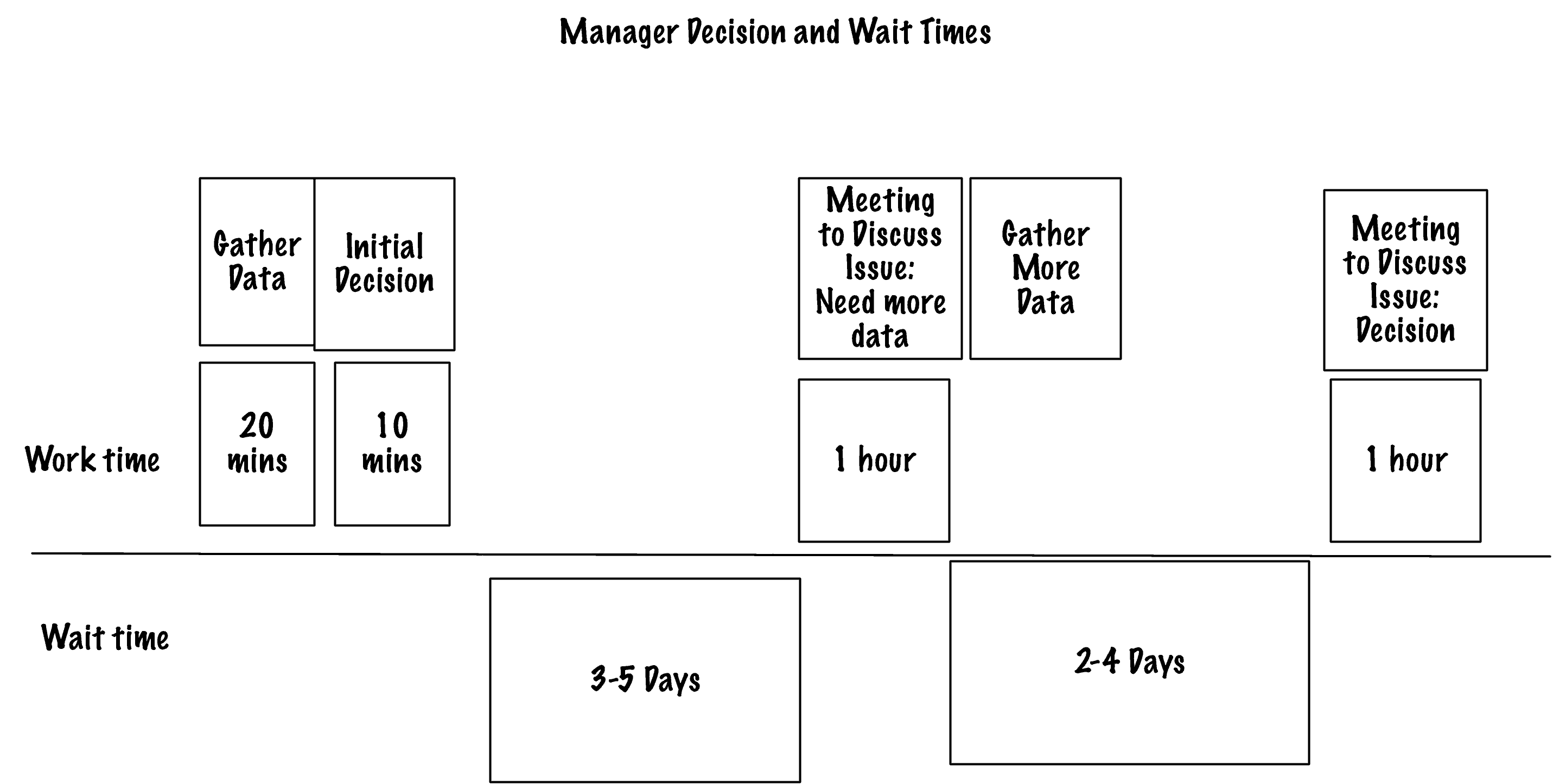
That's why we need the right people—and only the right people—to discuss and then make a reasonable decision. If you and your colleagues get stuck in long decision times, choose some data, decide and then choose (See Why Manage Management Decision Time for more details.)
I don't know of an organization that can tolerate long cycle times for management decisions. Instead, I only know of organizations that want to make decisions faster. We can shorten management feedback loops.
But what if you don't need an organization-wide risk-based decision? What if you just need a little information and then you can continue?
Use your network and try writing, not meeting.
Write and Ask Your Network Instead of Meeting
Too many managers do not realize they can use their organization-wide small-world network to get the information they need. Their networks include the teams they lead and serve, their cohort or colleagues, and people “far” across the organization. For networks, think up/down, across, and out. (Yes, this deserves its own blog post.)
Here are some alternatives:
- Start an email thread. Keep the participants to a minimum (maybe five or six people). State the problem and when you need an answer. Then, facilitate the thread.
- Consider a Slack/Teams thread in the same way. I find this more challenging because I can never tell when I will see an answer, and I don't know how to organize the information in the backchannel.
- If you are not a senior leader, you can choose what to do and ask for forgiveness. “I have this problem. I see this specific answer. If you don't comment by (some number of reasonable days later), I will implement this decision unless you tell me no, and offer an alternative.”
I admit, I am quite fond of asking for forgiveness later. You might not be. But writing these issues down and then writing down the decisions? That allows people to follow your decision-making process later. That helps other people understand why you thought this way and when.
It might also help you get back more time in your day.
Free More of Your Time So You Can Think
While I love collaborative ways of working, sometimes, that's not the answer. And even with a lot of collaboration, sometimes we all need more time to think, mostly alone.
As an extrovert, I love talking issues through. I often realize what I think when I talk. (Some of you introverts just shuddered and cringed.) However, I also learn what I think when I write.
If I'm busy all day, I'm not thinking in either form. Worse, I'm not doing my deep work, the work that only I can do to offer value to my various constituencies.
When we reconsider which meetings we need and when, we can get some of our time back to think.