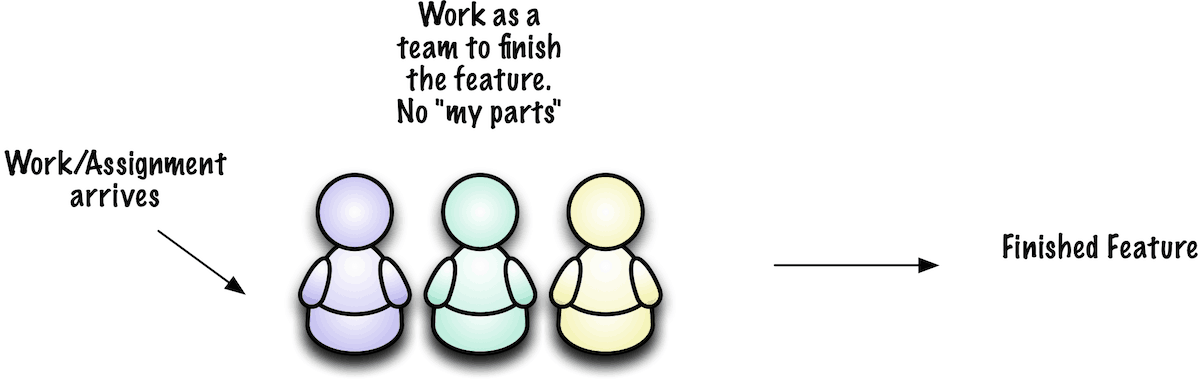
 I’ve heard that the AA/PMI wants to create a manifesto for enterprise agility. I’m not sure we need a manifesto, but that’s fine.
Here are the necessary conditions for enterprise agility:
- A culture of flow efficiency thinking. That means everyone collaborates across the organization to optimize up for one overarching goal.
- Limited planning horizons, with the expectation that plans will change.
- Funding teams, not initiatives.
- Deciding how much to invest as incremental funding when planning what to do next.
- Rewarding people based on how they contribute to the overarching goal, not any single person’s “individual” accomplishments.
Enterprise agility starts with managers and how they manage. This is a culture problem, not an operational problem.
Until managers reward collaboration at all levels, they cannot get flow efficiency thinking and actions.
It’s simple to explain and incredibly difficult to do because of cost accounting.
Cost Accounting Focuses Down to the Individual
Have you heard of the terms, “revenue per employee” or “profit per employee”? That’s where you take all the revenue, divide by the number of people in the organization, and generate a number.
That’s one way cost accounting focuses on the individual.
Here’s an example. Imagine a company of five people. They generate $1 million in revenue. That is $200,000 revenue per employee.
What does that even mean?
We all know that every person’s contribution changes as the work changes. Here are some of the valuable activities as that 5-person team develops a product:
- Some people bat around possible ideas, generating lots of potential avenues for the product.
- Others facilitate the discussions.
- Some people coach each other in discovery.
- Some people write code, tests, design the UI, etc.
- Other people focus on how to get the product out the door.
How do we possibly assign the revenue when people’s roles change as the work changes? Yet, cost accounting tries to do that.
It also instills the idea of an FTE, a Full Time Equivalent. That’s why some managers think two half-time people can do the job of one full-time person. That creates multitasking, where the manager assigns one person to two projects. They’re one person, but a .5 FTE on one project and .5 FTE on the other—a perfect example of resource efficiency thinking.
We all know the reality. That “half” a person will be unable to contribute effectively on either team.
I won’t even discuss earned value because that’s just nuts for software. (To be honest, most hardware, too.)
Enterprise agility requires a culture of collaboration and cost accounting can destroy that.
Necessary Management Actions to Create Enterprise Agility
There are three pieces to enterprise agility. They all start with a culture change to move to flow efficiency thinking.
A Culture of Collaboration
First, the culture part of people and their collaboration. Managers need to remove the barriers to collaboration. Here’s what that might look like for the big picture:
- Because managers create the culture, they need to choose which decisions need collaboration. (See below for the strategy and operational excellence experimental approach.)
- Manage and measure via flow efficiency thinking. Start with the flow metrics for managers. (Measuring teams reeks of cost accounting.)
- Encourage small-world networks of people across the organization for more collaboration. The more managers encourage people and teams to talk with each other, the easier it is for people to discover answers and learn with each other.
The more people feel free to collaborate, the more they feel free to experiment, both on strategy and tactics. Yes, this works for managers, teams, and workgroups.
A Culture of Experimentation for Corporate and Product Strategy
When people collaborate on one overarching goal, they can experiment faster:
- Instead of yearly or longer plans, consider monthly to quarterly plans. That will encourage treating all product development as an experiment. In addition, this allows for and encourages incremental funding.
- Very few organizations understand what differentiates them from their competitors. The more an organization feels free to experiment with strategy, the more experiments they can run. This requires three things: short team-based cycle time; ranking the work to focus on fewer experiments/projects/whatever; and limiting the number of experiments. Notice that the management’s flow metrics matter here. Managers need to discover the organization’s overarching goal through frequent iteration. Product managers might start with a product strategy, and they often need to evolve that, too. (Yes, that sounds exactly like what teams do to verify the customers want the product.)
- Reward people who help reduce the team-based cycle time, not “their” work. This works at all levels, from teams/workgroups, to their managers, to the middle managers, and up through senior leadership.
These ideas encourage a culture of experimentation, focused on an overarching goal.
A Culture that Rewards Collaboration and Influence
The third piece of organizational agility is about what the organization chooses to reward.
- Set goals that people can achieve only when they work together. (Never cascade “down” some top-level goal. Instead, generate projects that allow teams to reach that goal.)
- Reward people for supporting other people and teams.
- Review all the rules and regulations, especially about reporting project status and promotions. How many of those rules and regulations reinforce solo work? Fix those. People will need promotions outside of the “normal” dates. (Why create a yearly cadence when you want innovative thinking and experiments?) In addition, rethink how you reward people.
Back when I was a manager inside the organization, I had weekly one-on-ones with my staff. When they worked collaboratively with their teams, I had little insight into how they worked. Now, managers who lead agile teams have a similar problem. How can you see how people act? How do they treat each other?
Managers can’t often see that. Instead, the teams can see that. Teams always know who does the “best” work, even if the “best” is not something the managers can see. For example, some of us rarely see how valuable team-based facilitators are. Instead, all we know is that when Suzy or Tom is in the meeting, the meeting works better.
These ideas are not new. I’ve been writing about them and teaching them for decades. So have others. (See the reading list below.)
If it was easy, organizations would use these ideas now. It’s not easy, and that’s the challenge of enterprise agility.
The Challenges to Change the Culture
Enterprise agility can never be the outcome of a framework, as in “do this, and then do that.” Instead, consider these ideas:
- Start with Finance and HR. A culture change to flow efficiency thinking means their jobs change. Finance has to think about investment and value, not cost. HR needs to change everything about job ladders, feedback, and promotions. (I am not sure how many HR people have that ability to think strategically in flow efficiency, rather than in resource efficiency.)
- In parallel, start with the project portfolio. Assign one project to cross-functional teams. Fund those cross-functional teams.
- Plan for not more than a quarter at a time for everything: the product roadmap, the project portfolio, the strategy. Treat everything as an experiment.
- Move from component teams to cross-functional teams. Too many organizations still have functional or component teams with functional or component managers. How can the organization, in the midst of this culture change, support those managers as humans while “their” teams change out from underneath them? How do the team members feel when they are supposed to collaborate with people they don’t know?
I’m sure there’s more, but this probably feels overwhelming. In that case, start with the reading below.
The challenge is not to create a manifesto for enterprise agility. The real challenge is how to create a manifesto for modern management.
Modern Management and Enterprise Agility Require Significant Culture Change
The old ways of managing with short-term thinking and long-term planning, all based on individual work, are not sufficient. Not just for any kind of agility, but it’s not sufficient for business outcomes that matter.
We need long-term thinking, but short-term planning. Instead of individuals, we can base those plans on teams of people, all collaborating up for the good of the organization.
That collaboration up fulfills a strategy that serves their customers and their customers’ context. When organizations serve their customers, they make money. And they get to do it again and again.
That’s how enterprise agility works. With modern management and a culture change to flow efficiency thinking.
Recommended Reading
Any links here, other than to my books, are either universal or Amazon links. They have my affiliate code in them, so I might be able to buy a coffee if you click on them.
- I first learned about flow efficiency thinking in This is Lean: Resolving the Efficiency Paradox by Modig and Ǎhlström. (That’s a universal book link, where you can choose your favorite store. Yes, my affiliate code is embedded in the link.)
- To stop all the theater and nonsense of current promotion practice: Punished by Rewards, by Alfie Kohn. The Human Equation: Building Profits by Putting People First by Jeffrey Pfeffer. Beyond Budgeting: How Managers Can Break Free from the Annual Performance Trap by Hope and Fraser. (I have more references in Practical Ways to Lead and Serve Others.)
- Read anything by Peter Drucker, Gerald M. Weinberg, Bob Sutton, Jeffrey Pfeffer, and more for how they thought about people, teams, and the purpose of organizations.
- The Modern Management Made Easy books. The more managers think about flow efficiency and collaboration, the easier it is to manage the work. That includes projects, programs, and the portfolio. The seven principles support enterprise agility.
- Project Lifecycles: How to Reduce Risks, Release Successful Products, and Increase Agility. This book focuses on project-oriented feedback loops and how to shorten them.
- Manage Your Project Portfolio: Increase Your Capacity and Finish More Projects. Enterprise agility does start with limiting WIP and that’s the idea behind managing your project portfolio.
I’m reading some of Annie Duke’s books, all about knowing when to bet and when to quit. I have not yet started all the strategy books on my TBR pile.
A question for you: I’ve been thinking about this topic and writing about it for a while. Would you read a book (probably two books) about this topic if I write them? I’m not looking for a guarantee. Just an indication. Thanks.