 In How to Use Value Stream Maps to See Where AI Creates Bottlenecks Part 1, I described three teams that used LLMs. However, those teams only used LLMs as individuals, reinforcing resource-efficiency thinking instead of flow-efficiency thinking. (Resource efficiency makes everything take longer because of the focus on the individual. Flow efficiency allows the work to flow through the team, resulting in shorter cycle times. (See Flow Metrics and Why They Matter to Teams and Managers for more information.)
But, if you review the various value stream maps, the cycle time problems are all in the delays between the work.
That requires diagnostics: what’s happening in the team that creates these extensive delays?
I’ll first start with another value stream map, one that shows how people work on parallel items “at the same time.”
A Personal Parallel Value Stream Map
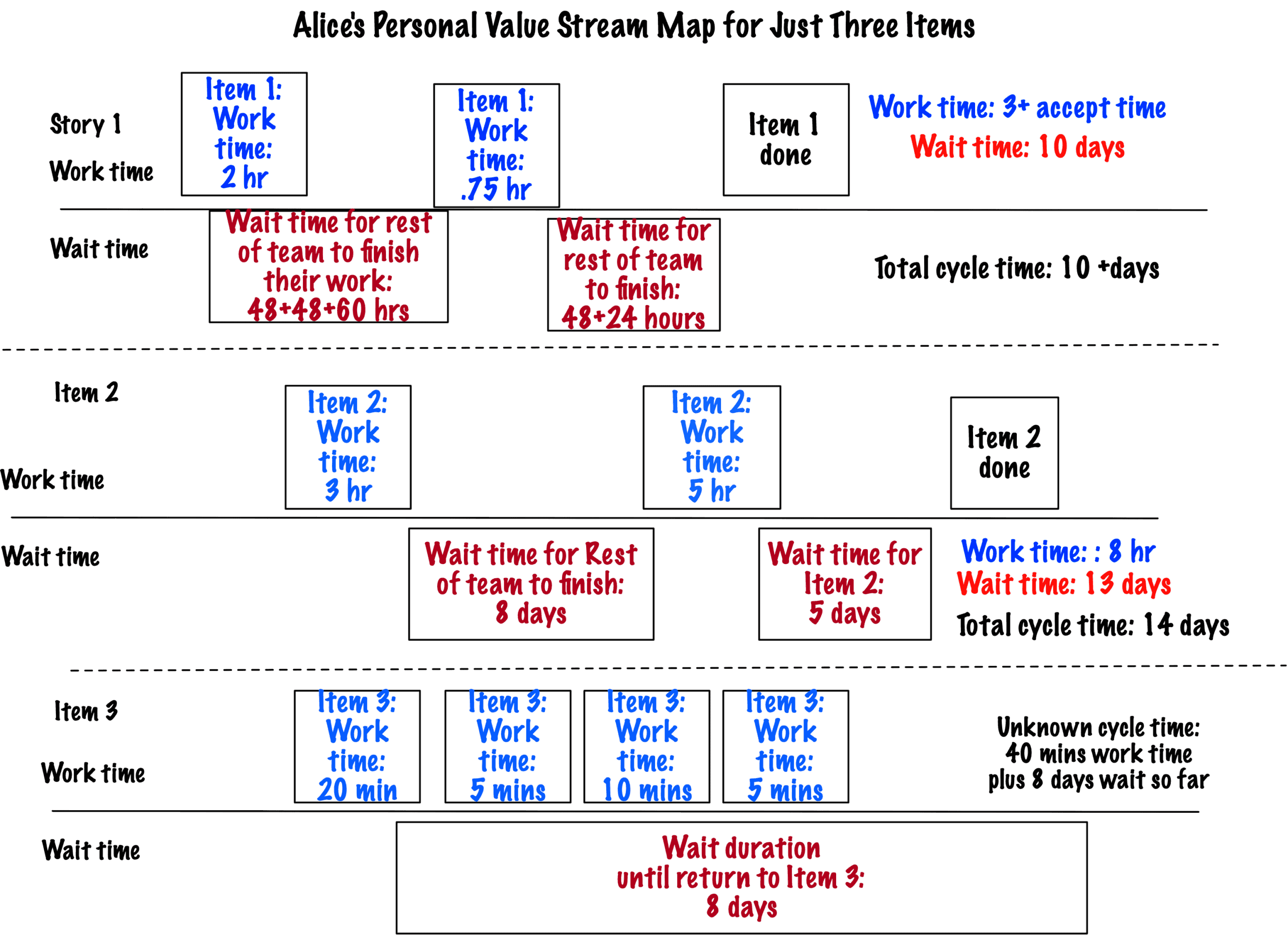 Resource efficiency thinking demands that people stay busy all the time. If people are blocked on one item, they will move to another item. That creates multitasking, and a personal value stream map that looks something like this. While I only included three parallel items, you can see how this visualization gets worse and worse, the more personal WIP (Work in Progress) a person has.
(This is an example of the agile schedule game “Everyone Start Your Own Story.” That leads to partially-finished work at the end of an iteration. See Create Your Successful Agile Project for more details.)
It’s not just WIP. Because of the way the flow metrics work, the work environment gets worse and worse. Everyone feels more pressure to deliver, but no one is working together to finish anything to an outcome.
- Everyone needs more work time to finish anything
- The wait times continue to extend, dwarfing the work times.
- Sometimes, we can’t tell if or when we can finish anything. See Item 3 work time at the bottom of this image. That’s where Alice finds a little time to pick away at this task for 20 minutes here, 5 or 10 minutes there, etc. She can’t make real progress, but someone feels she’s efficient because she’s busy.
What if you added AI/LLMs to Alice’s work? Probably nothing.
While value stream maps help us see the information for one work item, we need a different visualization to diagnose the problem(s). That’s a kanban board.
Use a Kanban Board to Show the Various States
When experts work alone on “their” work, the team’s WIP (Work in Progress) explodes. This board shows the work states for Alice, Ben, and Cody:
 Notice that a three-column board would just show all that in-progress work as “In Progress.” That’s not enough information to diagnose what’s going on. There are only three people on this team. They have 12 items in progress. Twelve! That’s nuts. Here are all the problems with that much WIP:
- No one can possibly keep the context for all that in-progress work in their heads.
- Returning to what they did before requires a ton of context switching. Do I know how much? No. But much more time than anyone might imagine.
Could you use an LLM to create a kanban board? I assume so. Would I trust that board? No. Because when the humans discuss what’s going on, they often discover more items and work in progress. That’s why I like a short retrospective to create the board and address the problems.
Conduct a Short Retrospective
When teams work as experts, you don’t need a long retro to see what’s going on and start fixing the problems. Instead, the team needs to focus on breaking the reinforcing feedback loop from the flow metrics. In this case, I would start with all the WIP.
Too often, people and teams get stuck on the old standup questions. Instead of a standup that focuses on a person (another example of resource efficiency thinking), walk the board as a team. Use the questions in Shorten Team Feedback Loops with These Three Questions to Increase Throughput to see the first thing the team can finish.
(If you are stuck on how to say no to more work, start with this post in a series: Saying No to More Work.)
For my AI enthusiasts, yes, I will do one last post about how I counsel my clients to use the LLMs to continue with diagnostics and create a better team environment.